Your Green Build Is Lying To You
I wrote a check that guaranteed no untranslated text could ship. It passed. The product still shipped English to people who do not read English. The problem was not the code the check looked at, it was the shape of the thing doing the looking.
I move fast and in a lot of directions at once. A dozen projects live at any given moment, and I am almost never coming back to a file I wrote three months ago. So I do not rely on remembering things. I rely on the build saying no.
That works right up to the moment a check tells you the truth about itself instead of about your code.
Here is the one that got me. A booking product I work on serves five languages. Every word a user reads has to come from a dictionary, in their language, no exceptions, because the people on the far side of it are external resellers nobody is supervising. An English label there is not a rough edge. It is a reseller who cannot finish a sale.
So I did the responsible thing. I wrote a static check that fails the build on any hard-coded user-visible string, wired it into CI, and scoped it to the screens that were finished. Builds went green. I moved on to the next project.
Then someone switched the language and read English.
The check was not wrong. It was narrow.
The check looked at text sitting between tags. That is the obvious place text lives, and it is where most of it does live. What it could not see was text passed as a value into a component, or text assembled from a template rather than written as a plain string. Those are not exotic. They are how half a modern component tree is written.
One tooltip in that product read "Theme: system" in all five languages for weeks. Its file scanned perfectly clean every single time, because the sentence was assembled rather than written, and my check only knew how to see written.
That is the part worth sitting with. The check was not buggy. It answered the question it was asked, correctly, every time. The question was just smaller than I thought it was.
The move that actually helped
I stopped trusting the report and tested the reporter.
I wrote a small file containing three deliberately untranslated strings, one in each shape I could think of, and ran the check against it. It found one.
One out of three. On a check I had already shipped, already wired into CI, already told myself guaranteed something.
That five-minute exercise was worth more than every green build it had produced. And it applies far past my situation, so here it is, straight:
A clean report is evidence about your scanner. It is not evidence about your code.
Every check you write has a blind spot shaped exactly like the thing it cannot parse. Coverage tools have it. Linters have it. Security scanners have it worst of all. The blind spot is invisible by construction, because the only thing that would reveal it is precisely the thing the tool cannot see. So the tool reports zero, and zero looks identical to safe.
The fix is not a better tool. The fix is a habit: when you write a check, write something it should catch, and confirm it screams. Then write the version you are least sure about, and check that one too. If you have never watched your guard fail, you do not have a guard. You have a green light.
When I widened that check to see the shapes it had been missing, the honest number of outstanding problems went up, not down. That felt like a regression and was the opposite of one. The number had always been that high. I had just been reading a smaller instrument.
Then the same lesson arrived from three more directions
Once you start questioning the shape of your checks rather than their output, you notice the pattern is not one bug. It is a category.
A check scoped to a folder says nothing about what that folder imports. I had a screen that was fully translated, fully guarded, passing everything, and it rendered an English word into the middle of a confirmation message in every language. The word came from a shared building block one directory over, outside the guarded zone. The guard was telling the truth about its folder. The folder was not where the problem lived.
A check that parses one file type cannot ever see the others. Some of the text in that product lived in a plain data structure rather than in a component: the column headings on a printed manifest. No improvement to a component scanner will ever reach them, no matter how good it gets. Not "did not reach". Cannot.
And a check that runs in one environment cannot speak for another. Messages the product sends outward, by email, have no component and no reader present at all. Whatever a component scanner concludes about them is a coincidence.
Four blind spots, one shape. In each case I had a green signal that was locally honest and globally meaningless.
When you cannot detect it, change the shape until it cannot be written
At some point adding a fifth check stops being engineering and starts being superstition. The better move, when you find a class of bug your tools structurally cannot see, is to make that class unrepresentable.
Take those printed column headings. The fix was not a smarter scanner. It was removing the place the English could sit. A column definition no longer holds a heading at all. It holds a pointer into the dictionary, and the only way to turn a column into something printable is to hand the whole set a language first.
Three things become true at once, and none of them relies on anyone remembering anything. There is nowhere to type an English heading, because no such field exists. A column that is missing from the dictionary will not compile. And because a heading can only be produced for a specific reader, every place that builds one of these documents is now forced to answer the question it had been skipping: in whose language?
That last one is my favourite consequence, and it is the one people underrate. The type did not just block a mistake. It surfaced a question the design had been avoiding.
There is a weaker version of this fix that looks identical and is not. You could let a column hold a function that returns a heading rather than the heading itself. Feels rigorous. Still lets someone write a function that returns "Time" and hands you the same bug in a fancier wrapper. Precision here is the whole game: the shape has to make the bad state impossible, not inconvenient.
The same trick worked on the shared building blocks. Instead of letting them carry a default English label, I made the label required. The compiler then handed me the complete list of every place that needed one. Not a sample. The list. And walking that list turned up two more instances of exactly the bug I had been hunting, in places no folder-scoped check would ever have looked.
That is the difference in one line. A guard finds instances. A type eliminates the category.
The layers, and why there are several
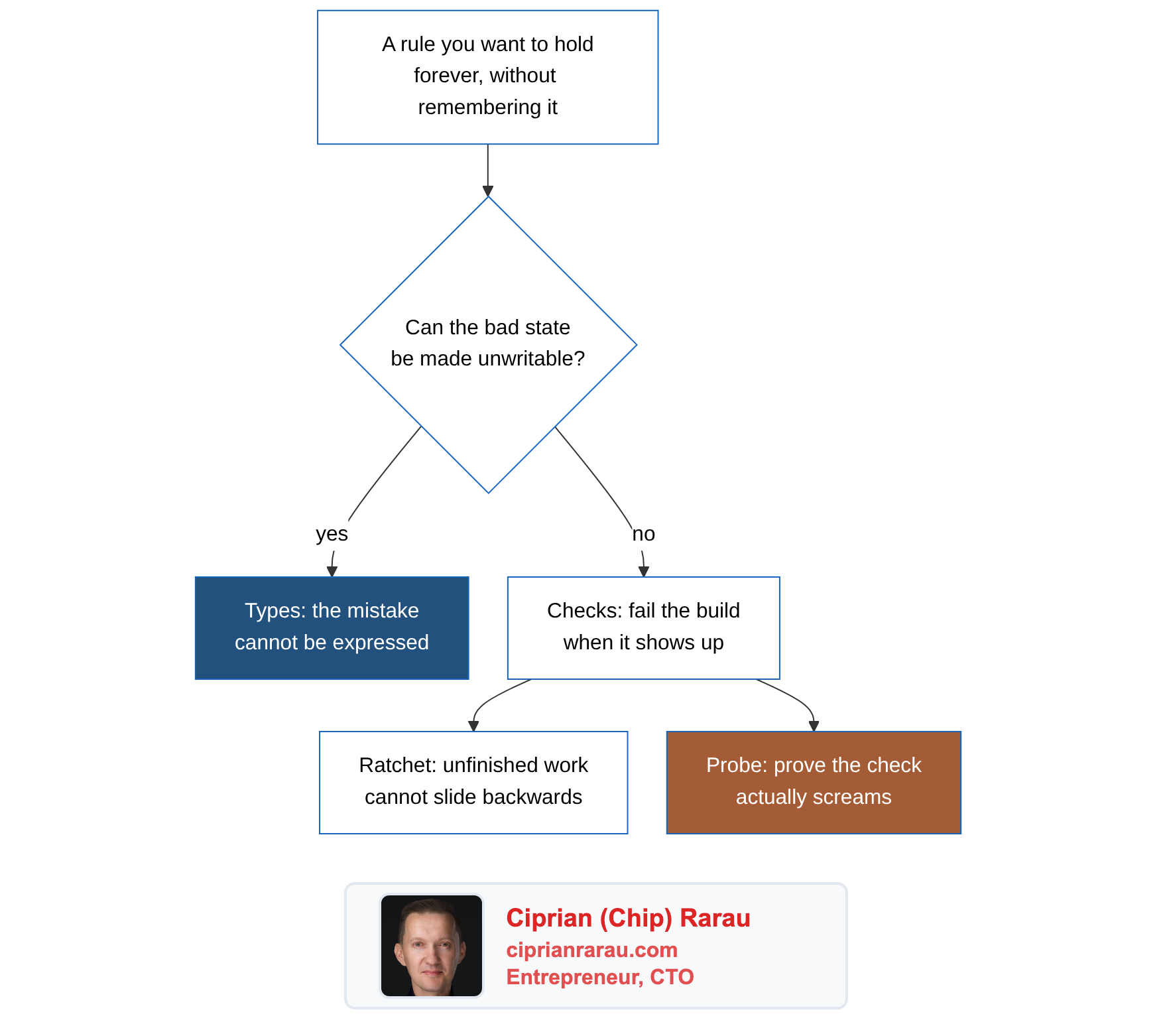
Types first, because they eliminate categories. Checks for what types cannot express. A ratchet underneath, because a check only protects the surfaces you have already finished, and the unfinished ones need to be prevented from sliding backwards while they wait their turn. And a probe against every check, because otherwise you are back to trusting a report.
The ratchet deserves its own sentence. Recording per-file counts and refusing to let any of them rise sounds bureaucratic and turned out to be the piece that made the whole cleanup safe. It is the only layer that does something useful about the mess you have not gotten to yet.
The one that stung
There is a last twist, and it is the most human failure in the whole story, so it is the one most likely to be yours too.
The automated tests were selecting things on screen by reading their labels. Perfectly reasonable while a label was a fixed English word. Then the label became translatable, which was the entire point of the work, and every one of those tests broke at once.
That is not a testing bug. It is a category error. A label is copy that exists for a human, and it is supposed to change: that is its job, in five languages, whenever someone decides a better word. The moment a test depends on its exact text, the label is doing two jobs with opposite requirements, and the one that wanted to change loses.
Anything a human is meant to read is a moving target by design. Tests need to hold onto something that is not.
What I actually took away
I did not come out of this with a better opinion about translation. I came out of it with a sharper question, and it is the one I now ask when someone tells me a check guarantees something:
What shape of mistake is this check unable to see, and what would it look like if that mistake were happening right now?
If the answer is "it would look exactly like this", you do not have a guarantee. You have a green build and a hypothesis.
I would rather find out which one I have on a Tuesday afternoon with a three-line probe file than find out from someone who switched the language and could not finish their booking.
Get the next post by email
One email when a post lands, from chip@ciprianrarau.com. No drip, no marketing, unsubscribe anytime.